Understand JWT and OAuth2 in Python. Learn token-based authentication, access tokens, refresh tokens and secure API access for modern applications — explained simply, with real examples.
https://www.tiktok.com/@fernancode/video/7629524713932623111?is_from_webapp=1&sender_device=pc
Introduction
Imagine building a mobile application that allows users to log in once and access different features without repeatedly entering their passwords.
How does the backend recognize the user when the application makes another request?
One common approach is token-based authentication.
JWT and OAuth2 are important concepts in modern API development, particularly when building applications that communicate with separate backends. For aspiring Python developers, understanding these technologies is an important step towards building professional backend systems — and while the names sound technical, the underlying idea is something you already understand from everyday life.
A Simple Way to Picture This Before We Get Technical
Think about visiting an office building that requires a visitor badge. You sign in once at reception, and they give you a badge. For the rest of your visit, you show that badge at different doors instead of explaining who you are and re-verifying your identity every single time. A token works the same way — you log in once, receive a token, and then present that token for every subsequent request instead of sending your username and password again and again.
What Is JWT?
JWT stands for JSON Web Token.
It is a compact token format that can carry claims (small pieces of information, like “who this user is” and “when this token expires”) between systems.
A JWT commonly contains three parts:
- Header
- Payload
- Signature
The header identifies the token type and signing algorithm. The payload contains claims, while the signature helps verify that the token has not been modified.
A JWT is usually signed, not encrypted — meaning anyone could technically read its contents if they got hold of it, but they can’t alter it without the system noticing. This is an important distinction: its contents should not contain passwords or other confidential information unless a separately designed encryption mechanism is used.
How JWT Authentication Works
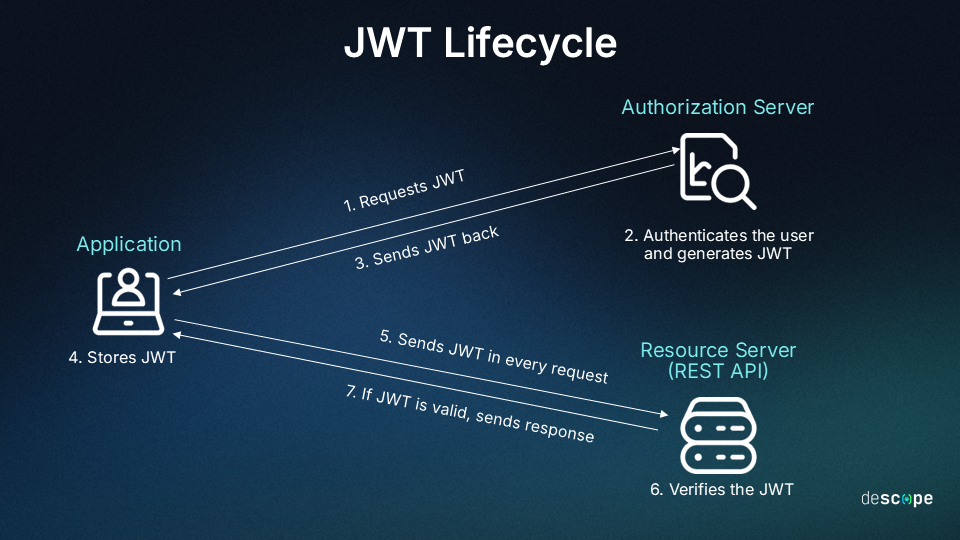
Consider a student accessing an online learning application.
- The student submits login credentials.
- The backend verifies the credentials.
- The backend issues an access token.
- The application stores the token using an appropriate secure mechanism.
- The application sends the token with subsequent API requests.
- The backend verifies the token before granting access.
A protected request commonly includes:
Authorization: Bearer YOUR_ACCESS_TOKENThis is the digital equivalent of showing your visitor badge at each door — the server checks that the token is valid and signed correctly before letting the request through.
What Is OAuth2?
OAuth2 is an authorization framework that allows an application to obtain limited access to resources through an authorization server.
For example, a user may choose to sign in to an application using an external identity provider — think of the familiar “Sign in with Google” or “Sign in with Facebook” buttons many apps use. Behind that convenient button, OAuth2 is what’s actually handling the process of safely granting that app limited access, without ever sharing the user’s Google or Facebook password directly with it.
OAuth2 defines flows that help applications obtain access tokens under specified conditions. OpenID Connect builds on OAuth2 to provide an identity layer for authentication — essentially adding “and confirm who this person actually is” on top of OAuth2’s “grant limited access” function.
JWT vs OAuth2
These terms are related but are not interchangeable. A simple way to remember the difference: JWT is a format for a token, while OAuth2 is a framework for how access gets granted in the first place.
JWT | OAuth2 |
|---|---|
| Token format | Authorization framework |
| Represents claims | Defines authorization flows |
| Can be used as an access token | Can issue access tokens in supported flows |
| Has a defined structure | Does not require all access tokens to be JWTs |
A system can use OAuth2 with JWT-formatted access tokens, but OAuth2 does not require JWT. Beginners often assume these are competing technologies that do the same thing — in reality, they usually work together, each solving a different part of the same overall problem.
Practical Example: Creating a JWT in Python
Install a JWT library:
pip install PyJWTA simplified example:
import jwt
from datetime import datetime, timedelta, timezone

SECRET_KEY = "replace-with-a-secure-secret"

payload = {
    "sub": "student_101",
    "exp": datetime.now(timezone.utc) + timedelta(minutes=15)
}

token = jwt.encode(
    payload,
    SECRET_KEY,
    algorithm="HS256"
)

print(token)
To verify it:
decoded = jwt.decode(
    token,
    SECRET_KEY,
    algorithms=["HS256"]
)

print(decoded["sub"])
For a real application, load the signing secret from secure configuration, validate required claims, and implement appropriate key rotation and token revocation strategies. This short example is deliberately simplified so beginners can see the core idea clearly — in a real production system, there’s more structure around it, which is exactly the kind of detail worth learning properly rather than copying a snippet blindly.
What Is a Refresh Token?
An access token is commonly short-lived — often valid for just minutes, by design, so that if it’s ever stolen, the window of misuse is small.
A refresh token can be used to obtain a new access token without asking the user to enter their password again.
For example:
- Access token: short-lived authorization for API requests.
- Refresh token: used to obtain a replacement access token.
Refresh tokens need strong protection, controlled rotation, and revocation mechanisms, since they’re effectively more powerful than access tokens — a stolen refresh token can be used to keep generating new access tokens indefinitely if it isn’t properly secured.
Practical Example: Mobile Application Authentication
Imagine building a Flutter application for a college.
The student logs in through a Python backend.
The backend validates the credentials and returns the required authentication information.
The mobile application then uses the access token when requesting:
- Course information
- Student profile details
- Examination results
- Registration records
The backend verifies the token and checks whether the student is allowed to access each resource. Notice that verifying the token and checking permissions are two separate steps — a valid token proves who the student is, but the backend still needs to confirm that this specific student is allowed to see this specific result or record.
A Common Beginner Mistake Worth Knowing About Early
A frequent mistake is treating “the token is valid” as the only check needed before returning data. In reality, a valid token only answers “who is this person” — your backend still needs a second check for “is this person allowed to see this specific thing.” Skipping that second check is one of the most common ways student projects (and even real production systems) accidentally leak one user’s data to another logged-in user.
What Should You Learn?
- Token-based authentication
- JWT structure and claims
- Signing and verification
- Access and refresh tokens
- OAuth2 concepts and authorization flows
- OpenID Connect fundamentals
- Token expiration and revocation
- Secure token storage
- API permission checks
This list can look long at first glance, but each item builds naturally on the one before it — by the time you’ve worked through access tokens and refresh tokens hands-on, OAuth2 and OpenID Connect stop feeling like separate, unrelated topics and start feeling like natural extensions of the same idea.
Learn Python API Security at DAZU Training Institute
DAZU Training Institute encourages practical software development and secure programming — and authentication isn’t taught as an isolated, abstract lesson. It’s taught through building real, working login systems for real applications, so the concepts stick because you’ve actually used them.
JWT and OAuth2 are useful concepts for learners who want to develop backend systems for websites, mobile applications, and business platforms. For example, you could build a Python API that supports a website, Flutter application, and Android application using a carefully designed authentication system — exactly the kind of multi-platform project many Kenyan businesses actually need built.
If terms like “signing,” “claims,” or “authorization flows” still feel unfamiliar at this point, that’s completely normal — authentication is one of those topics that becomes genuinely clear only once you’ve built it yourself, with someone experienced explaining the “why” behind each decision as you go. At DAZU, students don’t just read about JWT and OAuth2 — they implement login systems for real projects like student portals and mobile apps, test them against common mistakes, and learn to secure them properly, step by step, with direct support whenever something doesn’t make sense the first time. You leave not just knowing the theory, but having actually built the kind of secure authentication system employers and clients expect.
Explore courses: https://dazu.ac.ke/courses
Contact: +254 722 922 454
Frequently Asked Questions
1. Is JWT an authentication protocol?
JWT is a token format. It is commonly used in authentication systems but is not itself an authentication protocol.
2. Is OAuth2 the same as JWT?
No. OAuth2 is an authorization framework, while JWT is a token format.
3. Can Django use JWT?
Yes. Django applications can implement JWT authentication using compatible packages.
4. Can FastAPI use OAuth2?
Yes. FastAPI provides OAuth2-related security utilities that can be used to implement supported authentication and authorization flows.
5. Should JWT access tokens last forever?
No. Access tokens should generally have limited lifetimes, with an appropriate refresh and revocation strategy where needed.
6. Do I need to understand cryptography to learn JWT and OAuth2?
No. You don’t need deep cryptography knowledge to use these systems correctly — you need to understand the concepts (tokens, signing, expiration, permissions) and follow established, well-tested libraries rather than building your own encryption from scratch.
Conclusion
JWT and OAuth2 are important concepts for developers building modern APIs and connected applications.
Understanding how tokens work, how access is granted, and how credentials are protected will help you develop more secure backend systems — and once you’ve built it hands-on, it’s a far more approachable topic than the terminology first suggests.
Develop modern Python authentication skills with DAZU Training Institute — beginner-friendly, hands-on, and built around real projects.
Visit: https://dazu.ac.ke/courses
Contact: +254 722 922 454
Related articles
 programming/ coding FastAPI Python Framework: Learn to Build Modern and High-Performance REST APIs
 programming/ coding SQLAlchemy and Django ORM: Learn Python Database Management Without Writing Every SQL Query
 programming/ coding Authentication and Authorization in Python: Secure User Access in Backend Applications
 programming/ coding Python API Security: How to Protect Backend Applications from Cyber Threats
 programming/ coding Database Relationships in Python: Learn One-to-One, One-to-Many and Many-to-Many Relationships
 programming/ coding Python Application Deployment: Learn How to Launch Django and FastAPI Projects Online
 programming/ coding Python Programming Course in Kenya: Learn Functions, Data Structures and Practical Problem-Solving
 programming/ coding Python Programming Course in Kenya: Build Real-World Projects with APIs, Databases and Automation
You might also like
 security What is Cybersecurity? A Complete Guide for Beginners
Nov 16, 2026
 software development Software Engineering Course in Thika: Build Real Skills, Real Projects, Real Career Opportunities
Nov 13, 2026
 beauty el Nails, Acrylic Nails and Nail Art: Which Skills Should You Learn?
Nov 13, 2026
 beauty Beauty Skills You Can Learn and Turn Into a Profitable Business in Kenya
Nov 13, 2026
 beauty Manicure and Pedicure Course in Kenya: Everything You Need to Know
Nov 13, 2026
 beauty : How to Become a Professional Nail Technician in Kenya
Nov 13, 2026