
Explore advanced web development, frontend frameworks and backend programming in a software engineering diploma pathway at Dazu Training Institute.
https://www.tiktok.com/@dazuhub/video/7691686757074619666?is_from_webapp=1&sender_device=pc
Software Engineering Course in Thika: Progress to Advanced Web Development
Learning the basics of programming is an important achievement. However, building complete applications requires a deeper understanding of how different technologies work together.
A Software Engineering Diploma in Thika can be a pathway for learners seeking to progress beyond introductory coding into more advanced software development concepts.
At Dazu Training Institute, prospective students can enquire about diploma-level software engineering training and confirm the available modules, duration and entry requirements.
The following topics illustrate the advanced web development skills that learners may explore during the additional years of a diploma pathway.
1. Advanced Frontend Development
Frontend development focuses on the part of an application users see and interact with.
After learning HTML, CSS and JavaScript, learners can progress to more advanced topics such as reusable components, state management, form validation and responsive interface design.
Frameworks and libraries such as React can help developers build larger interactive applications.
Practical example: An online shopping platform
Imagine developing an online store for a clothing business in Thika. Customers should be able to browse products, select sizes, add items to a cart and review their orders.
To build this interface, you would need to understand:
Reusable interface components.
Product filtering and search.
Shopping cart logic.
Form validation.
Responsive design for mobile devices.
Communication with backend services.
This project demonstrates how frontend skills can be applied to a real business need.
2. Advanced Backend Development
Backend development is responsible for processing requests, applying business rules and communicating with databases.
A backend system may handle user registration, authentication, product management and order processing.
Frameworks such as Django can help Python developers organise backend applications.
Practical example: A school management system
A school may require a system that allows authorised staff to register students, record examination results and generate reports.
The backend must validate submitted information, enforce permissions and retrieve the correct records from the database.
A well-designed system should also handle errors without exposing sensitive information.
3. API Development and Integration
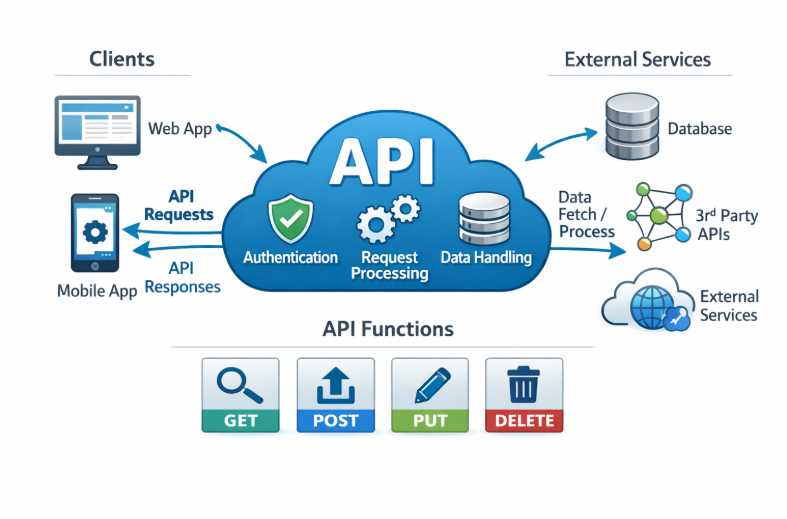
An Application Programming Interface (API) allows different applications to exchange information.
For example, a mobile application may request course information from a web server through an API. The server processes the request and returns structured data.
Learners can explore API concepts such as:
HTTP methods and status codes.
JSON data structures.
Request validation.
Authentication and authorisation.
Error handling.
API documentation.
Practical example: A student portal could use an API to retrieve a learner's course information and display it on a dashboard.
4. Software Architecture and Project Structure
As applications grow, developers must organise code so that it remains understandable and maintainable.
Software architecture involves deciding how application components are structured, how data moves between them and how responsibilities are separated.
For example, an e-commerce system may separate product management, customer accounts, orders and payment integration into clearly defined components.
This makes it easier to test, maintain and extend the application.
5. Collaborative Software Development
Professional software development often involves working with other developers.
Git helps track changes to source code, while GitHub can support collaboration, code reviews and project management.
Learners should become familiar with:
Creating and managing repositories.
Branching and merging changes.
Resolving merge conflicts.
Reviewing code.
Documenting projects.
Working with other contributors.
These skills are useful when moving from individual exercises to team-based software projects.
Build a Full-Stack Application
A valuable project is a complete business management application.
For example, you could build an inventory system with a responsive interface, a backend API and a database.
The application might allow users to register products, update quantities, search stock and generate reports.
Developing this project helps you understand how the frontend, backend and database work together.
How the Diploma Pathway Builds on the First Year
A longer software engineering pathway can build upon foundational programming skills by introducing more complex applications, larger projects and advanced development practices.
Before enrolling, confirm which modules are covered in each year of the diploma and whether students must complete a project or assessment to progress.
Study Software Engineering at Dazu Training Institute
If you want to move from basic coding towards building complete web applications, speak with Dazu Training Institute about its diploma programme.
Ask the admissions team to explain the official curriculum, practical assignments, project requirements and current programme fees.
Location: Witeithie House, 5th Floor, Room 529, Thika.
Phone/WhatsApp: 0722 922 454.
Email: admin@dazuhub.com.
Website: https://www.dazu.ac.ke/
Frequently Asked Questions
1. What is full-stack development?
Full-stack development involves working on both the frontend and backend of an application, including how the application interacts with databases and external services.
2. Is React useful for software engineering students?
React is a popular JavaScript library for building user interfaces. It can be useful when developing interactive web applications.
3. Why should I learn APIs?
APIs allow applications to communicate with other systems, making it possible to integrate services and share data.
4. Do I need programming fundamentals before studying advanced web development?
Yes. Understanding variables, functions, data structures and basic web development makes advanced topics easier to learn.
5. What should I ask before enrolling in the diploma?
Ask for the official curriculum, entry requirements, duration, current fees, assessment methods and details of practical projects.
Related articles
 software development Software Engineering Course in Thika: Build Real Skills, Real Projects, Real Career Opportunities
 software development . Is Software Engineering Worth Studying in Kenya in 2026? Career Opportunities and Salaries
 software development Diploma in Software Engineering: What You Will Learn and Where It Can Take You
 software development How to Become a Software Engineer in Kenya: Skills, Courses and Career Opportunities in 2027
 software development 4 Best Software Engineering Courses in Nairobi and Online
 software development Software Engineering Diploma in Thika: Mobile App Development, Testing and Final-Year Projects
 software development Software Engineering Diploma in Thika: Learn Databases, APIs, Security and Cloud Deployment
 software development Software Engineering Course in Thika: Learn Coding and Build Real Projects in One Year
You might also like
 security What is Cybersecurity? A Complete Guide for Beginners
Nov 16, 2026
 beauty el Nails, Acrylic Nails and Nail Art: Which Skills Should You Learn?
Nov 13, 2026
 beauty Beauty Skills You Can Learn and Turn Into a Profitable Business in Kenya
Nov 13, 2026
 beauty Manicure and Pedicure Course in Kenya: Everything You Need to Know
Nov 13, 2026
 beauty : How to Become a Professional Nail Technician in Kenya
Nov 13, 2026
 caregiver How Caregiving Can Open Doors to International Employment Opportunitie
Nov 12, 2026