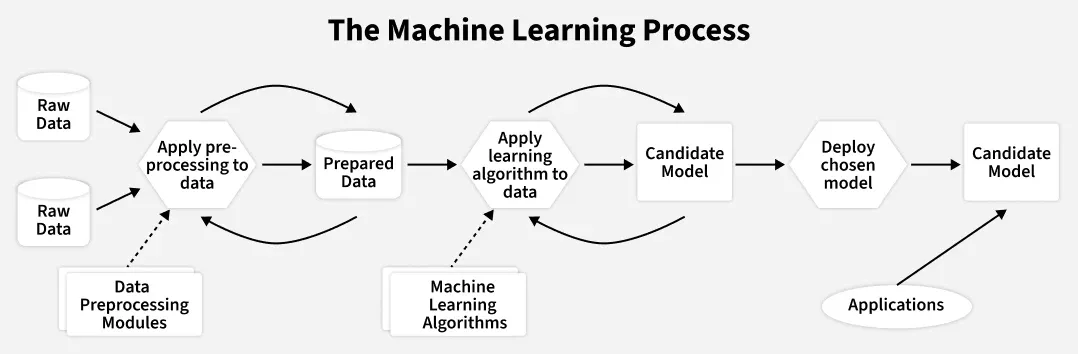
Machine learning stops being abstract the moment you build your first working model. Here's the practical workflow behind it, and how Dazu Institute can help you get there.
Machine learning is no longer limited to research laboratories or large technology companies it is becoming an essential part of modern software development, business intelligence, and data-driven decision-making. Python, supported by its extensive ecosystem of data and machine learning libraries, provides an accessible yet powerful environment for developing intelligent applications.
Building your first machine learning model is an important step toward understanding how artificial intelligence works in practice. It involves moving from raw data to a trained model capable of identifying patterns and making predictions. In this article, we explore the fundamental workflow of developing a machine learning model with Python, providing a practical foundation for learners who want to progress from programming and data analysis into machine learning.
Step 1: Starting With a Clear Problem, Not Just Data
Before writing any code, a machine learning project starts with a specific question predicting customer churn, estimating housing prices, classifying types of transactions. Defining this problem clearly shapes every decision that follows, from what data you need to what kind of model makes sense. Skipping this step and jumping straight into data is one of the most common mistakes beginners make.
Step 2: Collecting and Understanding Your Data
Once the problem is clear, the next step is gathering relevant data and understanding its structure what columns exist, what each one represents, and how complete or messy the dataset actually is. Using Pandas, learners explore the dataset's shape, check for missing values, and get a general sense of what they're working with before attempting any analysis.
Step 3: Cleaning and Preparing the Data
Raw data is rarely ready for modeling as-is. This stage involves handling missing values, correcting inconsistent formatting, and converting categorical information (like text labels) into a numerical form that a machine learning model can actually process. This preparation stage often takes more time than any other part of the workflow, but it directly determines how reliable the resulting model will be.
Step 4: Exploring the Data Before Modeling
Before training a model, it's important to explore relationships within the data which factors seem to correlate with the outcome you're trying to predict, and whether there are obvious patterns or anomalies worth investigating. Basic visualization tools help here, giving learners a visual sense of the data before committing to a specific modeling approach.
Step 5: Splitting Data Into Training and Testing Sets
A critical step in building a reliable model is separating the data into a portion used to train the model and a portion kept aside to test it. This ensures that when you evaluate the model's performance, you're testing it on data it hasn't already seen which gives a realistic picture of how it might perform on new, real-world data rather than just memorizing the training set.
Step 6: Choosing and Training a Model
With prepared data in hand, Scikit-Learn provides a consistent way to select a machine learning algorithm suited to the problem whether that's a classification model to predict categories, or a regression model to predict a numerical value and train it on the prepared training data. Beginners often start with simpler models, which are easier to understand and interpret before moving to more complex approaches.
Step 7: Evaluating the Model's Performance
Once trained, the model is tested against the data set aside earlier, using metrics appropriate to the problem accuracy for classification tasks, or error measurements for regression tasks. This step reveals whether the model is actually useful, or whether it needs further refinement, additional data, or a different modeling approach altogether.
Step 8: Refining and Improving the Model
Rarely does a first attempt produce the best possible model. This stage involves adjusting parameters, trying different algorithms, or improving the underlying data preparation based on what the evaluation revealed a normal, iterative part of machine learning work rather than a sign that something went wrong initially.
Step 9: Understanding This as a Repeatable Workflow
Once learners work through this process on one project, the same fundamental workflow define the problem, prepare the data, train the model, evaluate, refine applies across countless other machine learning projects. This is what makes building a first model so valuable: it's not just one project completed, but a repeatable process learners can apply to new problems going forward.
Why This Foundation Matters Before Moving to Advanced Techniques
Understanding this complete, fundamental workflow gives learners a solid base before exploring more advanced areas of machine learning, such as deep learning or natural language processing. Skipping ahead to advanced techniques without this foundation often leads to confusion, since many advanced methods still rely on the same underlying principles of data preparation, training, and evaluation.
Come Build This Skill at Dazu Institute
If you're ready to move beyond reading about machine learning and actually build your first working model, Dazu Institute is a great place to start. Our machine learning training walks learners through this exact workflow using real datasets and real projects from defining a problem and preparing data, through training and evaluating a model so you finish with genuine, hands-on experience, not just theoretical knowledge. Whether you're coming from a programming background or just starting out with Python, come learn these skills at Dazu Institute and take your first real step into machine learning.
Related articles
 security What is Cybersecurity? A Complete Guide for Beginners
 software development Software Engineering Course in Thika: Build Real Skills, Real Projects, Real Career Opportunities
 beauty el Nails, Acrylic Nails and Nail Art: Which Skills Should You Learn?
 beauty Beauty Skills You Can Learn and Turn Into a Profitable Business in Kenya
 beauty Manicure and Pedicure Course in Kenya: Everything You Need to Know
 beauty : How to Become a Professional Nail Technician in Kenya
 caregiver How Caregiving Can Open Doors to International Employment Opportunitie
 caregiver Is Caregiving a Good Career? Salary, Opportunities and Career Growth in Kenya
You might also like
 caregiver 5 Reasons Why Young People Should Consider a Career in Caregiving
Nov 12, 2026
 caregiver How to Become a Professional Caregiver in Kenya: A Complete Beginner’s Guide
Nov 12, 2026
 caregiver How to Become a Professional Caregiver in Kenya: Training, Skills and Career Opportunities
Nov 11, 2026
 beauty Beauty therapy course Kenya, beauty training Nairobi, beauty and cosmetology course
Nov 11, 2026
 data . How to Become a Data Scientist in Kenya: Skills, Courses and Career Paths
Nov 11, 2026
 security . Ethical Hacking vs Cybersecurity: Which Career Should You Choose in Kenya?
Nov 11, 2026